Tuesday, March 15, 2016

21 Settings, Techniques and Rules All New Camera Owners Should Know


Introductions to Useful Modes and Settings on Your Digital Camera

Photography Settings, Techniques and Rules
1. Digital Camera Modes Explained – I spoke with a family friend recently who had just bought a new point and shoot camera. She came up to me with her camera when no one was watching and embarrassedly asked me if I could tell her what all the little icons on the dial on top of her camera meant. This article explains what each of these most common digital camera modes means and does. Knowing them can take your shots to the next level.
2. Aperture and Shutter Priority Mode – this introduction talks you through these two very useful settings that can be found on many digital cameras. Aperture and Shutter Priority modes take you out of Automatic mode giving you more control over your images – but don’t thrust you fully into manual mode – they are great settings to explore and master.
3. Introduction to White Balance – one of the most common problems that I see in beginner photographer images are shots with incorrect color. We’ve all seen them – portraits where your subjects teeth and eyeballs (and everything else) has a yellowish tinge. Learn what causes this and how to combat it with this tutorial on White Balance.
histogram.jpg4. Understanding Histograms – ‘histograms are scary’ – this is what one reader said to me recently when they discovered that they could view these little graphs or charts on their camera. While they might seem a little technical it is amazing how simple a histogram is to interpret. Know what you’re looking for and with just a glance you’ll know if your image is under or over exposed. It’s a useful tool to master.
5. Automatic Exposure Bracketing (AEB) – this feature is another of those often unexplored settings that many cameras have built into them that will allow you to get well exposed shots in even the trickiest of lighting situations.

Other Basic Camera Techniques

How to Hold a Camera
6. How to Hold a Digital Camera – this beginner tutorial covers a topic that most camera owners skip over without realizing that it is a foundational lesson in photography. Get this wrong and it can impact the quality of your shots.
7. Shutter Release Technique – another ‘basic’ or ‘beginner’ type tip that many do intuitively – but which can drastically improve your photography if you don’t do it.
8. How to Use Focal Lock – yet another beginner technique that many of us take for granted yet which is at the core of how all digital cameras focus automatically. Get this wrong and you’ll take a lot of shots of out of focus subjects and in focus backgrounds!
9. How to Take Sharp Digital Images – ‘my shots are fuzzy’ – it’s a common problem that we’re asked about at DPS so we wrote this tutorial to refer people to to help them get the sharpest images that their camera can take.
10. Shooting with an In Camera Flash – flash photography with an in built flash can lead to some terribly blown out images – here are a few tips on how to avoid them. On a similar topic – here’s 7 Strategies for Avoiding Flash Blow Out.
11. How to Get Shallow Depth of Field in Your Digital Photos – a great technique to learn if you’re into many types of photography (portraits, macro etc) is how to control the depth of field in your shots and make your main subject ‘pop’ out by making your background nicely blurred – this tutorial talks you through how to do it.
12. Understanding Exposure – this post talks new camera owners through the three main elements of Exposure. Once you’ve read it also check out our introductions to ISO, Aperture and Shutter Speed.

Camera Care and Maintenance

camera care
13. How to Avoid a Dirty DSLR Sensor – one of the fastest ways to ruin every single shot you take with your new DSLR is to end up with a dirty image sensor. This tutorial gives some basic tips on how to ensure it stays as clean as possible.
14. How to Clean a DSLR Lens – as much as you try to protect them – lenses tend to get a little grimy over time. This tutorial shares some basic tips on how to clean them up so that your shots will be as clear as possible.
15. 7 Digital Camera Predators and How to Keep them at Bay – this tutorial talks you through 7 of the most common ways that digital cameras get damaged – what to look out for and what preventative action to take to avoid them.

Composition Tips

rule of thirds
16. The Rule of Thirds – whether you know it to follow it or break it – it’s something you should at least know about.
17. Points of Interest – an image without some visual point of interest in it is unlikely to hold the eye of anyone viewing it.
18. Getting Horizons Horizontal – the perfect way to ruin that lovely sunset or landscape shot is to make it lean to one side. Get your Horizon Horizontal!
19. Fill Your Frame – this is not applicable to every shot you take but many photographers could drastically improve their photography by getting in close to their subject and filling their frame.
20. Getting Backgrounds Right – the background of your shot can make or break your image. This tutorial talks you through a number of things to look out for and techniques to use to get them just right.
21. Adding Randomness to Your Photos – learn how to set your images apart from everyone else’s by injecting creativity, variety and a little randomness into your shots.
Of course the above 21 Settings, Techniques and Rules for beginner camera owners just scratch the surface of all there is to learn about the art of photography. Subscribe to our blog here (via email or RSS) to get more free daily tips to help you keep improving and learning.

Photographing Buildings [Composition Tips]


I am a firm believer, at least with photography, that what you get back is directly related to the effort you put in. As with all activities, it’s certainly not linear and I am the first to admit that you can tip the scale in your favor to achieve some great architectural images armed with only a few basic techniques.
photographing-buildings-1.jpg
For me, I think the allure of shooting buildings started as a tourist. We all do it, albeit some with less style and grace than others – yes you leaning tower of Pisa holder up’ers, I am talking about you! So there you are, standing in front of an awesome and aged icon of a building and with little thought other than fitting the structure into the LCD’s frame, you snap away. I know I did. The problem is that the hastily captured image is more than likely just going to be just that, a snap.
I have a mental checklist i go through when i pass a building that catches my eye, so the following techniques apply to all aspects of photography really but, specifically for architecture, you will see significant improvement.

Why?

photographing-buildings-2.jpg
Most of the time this question of why you are going to take a picture or rather what caught your attention will be obvious. It’s pretty simple when your building is freakishly tall, like Canary Wharf Tower in London, or a pier that stretches to the horizon which, in the UK, would be located in Southend. I know you all are thinking this is a little bit redundant, but far from it. Consciously visualizing what you thought interesting about this particular building will help you work out how to compose a shot to capitalize on that feature.
Features aside, there are a couple of basic errors to avoid; keep horizons and horizontals level, verticals vertical and ensure the image is sharp. You might disregard some or all of these, but always initially frame with these in mind because no image looks more unprofessional than a wonky or blurry one!
The most used compositional styles employed by architectural photographers will be one of the following.

Leading Lines

photographing-buildings-3.jpg
Perspective and depth are the usual drivers for leading lines, but the more obvious definition is a scene that directs the viewer’s gaze along an intended path. The elements in the image above – escalator, grooves in the roof and wall and the ‘ladder‘ in the distance – all lead your eyes up and toward the exit. The curvature of the ‘grille‘ in the roof serves as the final area of focus. My intention with this image was for the viewer to participate in a small journey. I also chose this perspective, with the distorted view of the escalator, to provide the viewer a sense of scale; especially relevant as most will not have visited this particularly grand London Underground station.

Dominant Facias

photographing-buildings-4.jpg
This building is pretty ugly and it is closely surrounded by other non complimentary buildings… apart from this elaborate design on the front of Moorfield’s Eye Hospital. There is so much glass in the balcony and facia, the light play is amazing. Another compositional element that everyone bangs on about, and quite rightly, Rule of Thirds; the invisible tic tac toe shaped grid where you place objects of focus along its lines and intersections. Well it works! You should always consider it when framing a scene, even if you decide otherwise.

Specific Detail(s)

photographing-buildings-5.jpg
I love spiral staircases. They are an awesome detail in buildings and a contrast to the usual straight lines and angles found in architectural images. This one is in Queen’s House in London. There’s very little context here apart from the stair case itself. You have no idea where it is or what the rest of the building might look like.

The Contextual Environment

photographing-buildings-6.jpg
These doorways connect adjoining rooms in a family dormitory. This building, amongst others, is to be found in Kolmanskop, Namibia. A long since abandoned town that served the families and workers at the local diamond mine. The sands of the Namib desert have invaded all of these houses and, along with the peeling wallpaper, frames, and faded walls contribute to a real sense of their abandonment.

Symmetry

photographing-buildings-7.jpg
I chose this straight down the line composition, at London’s Natural History Museum, to give a real sense of depth. The power of the image is in the symmetry and off horizontals and verticals would have a serious impact.
Oh yes, and remember to look up!

9 Composition Techniques to Use to Improve Your Photography


There’s a lot to learn when you’re starting out in photography and one of the key areas to experiment with is that of composition techniques.
While some call these ‘rules’ for many they are simply things to get your head around so that you can make better choices while composing your images (either by using them or ignoring them).
This video – based upon the photography of Steve McCurry – looks at 9 such composition techniques that will be useful for those starting out (and maybe a few of us who are a bit further along). We’ve included links to tutorials on each of the techniques below the video.
Video Source: Cooph

Further Reading on the Composition Techniques Mentioned in The Video

We’ve touched on each of these techniques (and many more) in the archives of Digital Photography School. So if one of the techniques has piqued your interest – here’s where you can learn more.

1. The Rule of Thirds

rule of thirds

2. Leading Lines

leading lines

3. Diagonals

diagonals

4. Framing

framing

5. Figure to Ground

figure to ground

6. Fill the Frame

Fill the frame

7. Center Dominant Eye

dominant eye
We’ve not written specifically on this topic but will put the challenge to our authors. Here’s a short article on the topic for you in the mean time.

8. Patterns and Repetition

pattern

9. Symmetry

symmetry

How To Lift the Quality of Your Blog Posts with Embeddable Content


pexels-photo-59628
There is an incredible opportunity for bloggers that will help improve the quality of their content, serve their readers better, and potentially help their blog rank higher in search engines – and not everybody is making use of it!
While as a judge in a recent blogging competition, I was asked to consider the quality of 20 social media blogs, and what stood out to me was how dynamic content could be when it is embedded. Such a simple tactic, but so incredibly effective!
It also spoke volumes that by the time the scores were revealed, the top 10 blogs chosen almost all used embeddable content.
Recently I spoke at a conference in Sydney and shared some tips on how to take blog content to the next level, and I was full of all the ideas I’d just seen those amazing blogs put out. As I prepared my talk I focused quite a bit on how bloggers can use embeddable content in their blog posts, and came up with 17 ideas to choose from – by no means definitive, but a good starting point!
I share those ideas in today’s episode of the ProBlogger Podcast.

Why embed?

Apart from the instances I mentioned earlier about dynamic content, higher search ranking, and serving your readers better, embeddable content is incredibly helpful for:
  • Increasing the usefulness of your content
  • Making your content more appealing to different learning styles and personalities
  • Showing your readers you’re willing to go to the extra mile to bring them great content
  • Adding other voices, opinions and experience to your blog
  • Increasing time on page and reducing bounce rate

Before you hit publish:

Brainstorm some ways you could lift your content with embeds.
  1. What could you create or curate that you could add to your post that would add value?
  2. Ensure it’s quality and not just there for the sake of having embedded content
  3. Don’t overdo it – a couple is fine
  4. Think about what would enhance the topic.
You can find the show notes for today’s episode here. Do you use embedded content on your blog?

7 Things I know about making money from blogging


1. It is possible

I’ve been blogging for just under ten years and for nine of those I’ve been making money blogging. It started out as just a few dollars a day but in time it gradually grew to becoming the equivalent of a part-time job, then a full-time job, and more recently into a business that employs others.
I used to talk about the specific levels of my earnings when I started ProBlogger but felt increasingly uncomfortable about doing so (it felt a little voyeuristic and a little like a big-headed boasting exercise and I didn’t really see the point in continuing to do it)— but my income has continued to grow each year since I began.
On some levels I was at the right place at the right time—I got into blogging early (in 2002 … although I felt I was late to it at the time) and have been fortunate enough to have started blogs at opportune times on the topics I write about.
However I know of quite a few other bloggers who make a living from blogging, many of whom have not been blogging anywhere near as long as I have.
For some it is a hobby that keeps them in coffee; for others it is the equivalent of a part time job/supplementing other income from “real jobs” or helping their family out as they attend to other commitments (raising a family). For others it is a full-time thing.
I’ll give you some examples below.

2. There is no single way to monetize blogs

Recently at our Melbourne ProBlogger event I featured numerous Australian bloggers in our speaker lineup who fit somewhere in the part-time to full-time spectrum. They included:
The year before, we had others, including:
Most of these bloggers are full-time (or well on the way to being full-time bloggers). They come from a wide array of niches and all monetize quite differently—doing everything from selling advertising, to having membership areas, to selling ebooks, to running affiliate promotions, to promoting their offline businesses, to selling themselves as speakers, to having book deals, and so on. Many have a combination of different income streams.
They are all also Australian, and are just the tip of the iceberg in terms of what is happening here in Australia—the same thing is being replicated around the globe.
There are many ways to monetize a blog. To give you a quick sense of the many methods check out this “money map” I created a year or so back, which outlines just some that I brainstormed (click to enlarge).
Ways to Make Money Blogging.png
I also recorded this free hour-and-twenty-minute webinar giving an introduction to the topic.

3. There are no formulas

From time to time, people have released products that claim to be formulas for success when it comes to making money online. They outline steps to follow to “guarantee” you’ll make money.
In my experience there is no formula.
Each full-time blogger I’ve met in the last ten years has forged their own path and has a unique story to tell. They have often acted on hunches and made surprising discoveries along the way.
There are certainly similarities in many of the stories but each blogger has their own personality and style, each one is reaching a different audience, and each niche tends to monetize differently.
The key lesson is to be aware of what others are doing and to learn what you can from each other, but to also be willing to forge your own path as well!

4. Many niches monetize

One common critique of the topic of monetizing of blogs is that the only people making money from blogging are the ones writing about how to make money blogging.
This is simply not true.
In the above list of speakers from our Melbourne event you’ll notice I included topic/niche of each blogger. None sell products teaching others to make money blogging—all are on blogging on “normal,” every-day topics.
My own experience of having a blog about blogging (ProBlogger) and a blog about Photography is that it is my photography blog that is by far the most profitable blog (I’d estimate it’s ten times more profitable).
I’ve interviewed numerous full-time bloggers of late in a webinar series including:
Interestingly, none of them make money by teaching others to make money online. Sarah largely blogs about health and wellbeing, Tsh blogs about simple living, and Ana blogs about woodwork.

5. Most bloggers don’t make a full-time living from blogging

Every time I’ve surveyed readers of ProBlogger about their earnings, we’ve seen that those making money from blogging are in the minority.
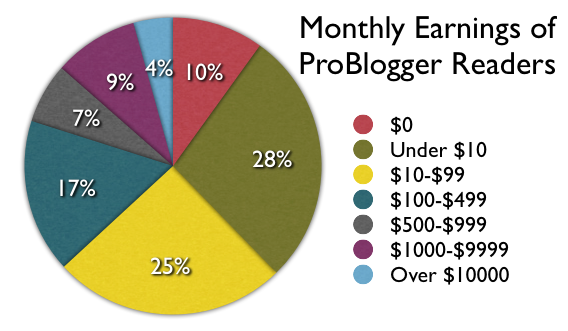
In a recent survey of 1500 ProBlogger readers we asked about their monthly earnings. What you’re seeing below is the spread of earnings from readers who are attempting to make money blogging (note: not all ProBlogger readers attempt to make money, so not all are included in these results).

Keep in mind that ProBlogger readers are generally newish bloggers—about half of those who took this survey had been blogging for less than two years.
So of those trying to make money blogging, 10% don’t make anything and 28% are making less than 30 cents per day. A total of 63% make less than $3.50 per day.
Let’s be clear—most bloggers who are attempting to make money are not making a living from blogging.
Having said that, of the 1508 bloggers surveyed 65 (4%) are making over $10,000 per month (over six figures per year) and a further 9% were doing over $1000 per month (which is at least a part-time level of income).
My feeling, having been attending blogging conferences for six or so years now, is that the number of full-time bloggers is on the rise, and there are actually quite a few more people now at least making the equivalent of a couple of days’ work a week in income from their blogs.
However, most bloggers don’t make much.

6. It takes time to build

When I dig down into the stats from the survey on income levels above, and do some analysis of those who are in the top income bracket, it is fascinating to look at how long they’ve been blogging.
85% of those in that top income bracket have been blogging for four years or more. Almost all of the others had been blogging for three or four years.
This certainly was my own experience. I blogged for a year without making money and once I started monetizing it was around two years of gradual increases before I approached a full-time income level. It would have been four years before I joined that top bracket of income (over $10,000 per month).
Blogging for money is not a get-rich-quick thing. It takes time to build an audience, to build a brand, and to build trust and a good reputation.
And of course even with four or five years of blogging behind you, there’s no guarantee of a decent income.

7. It takes a lot of work

Longevity is not the only key to a profitable blog. The other common factor that I’ve noticed in most full-time bloggers is that they are people of action.
Passivity and blogging don’t tend to go hand in hand.
Blogging as “passive income stream” is another theme that we hear in many make-money-blogging products, however it is far from my own experience.
I’ve worked harder on my business over the last ten years than I’ve worked on anything in my life before this. It is often fun and gives me energy, but it takes considerable work to create content on a daily basis, to keep abreast of what’s going on in the community, to monitor the business side of things, to create products to sell, to build an audience, and so on.
The four main areas to focus upon in building profitable blogs are (click each for further reading):
  1. Creating Great Blog Content
  2. Finding Readers for Your Blog
  3. Building Community on Your Blog
  4. Making Money/Monetizing Your Blog
The key is to build blogs that matter to people, that are original, interesting, and helpful. But this doesn’t just happen—it takes a lot of work.

The 5 basic steps to make money blogging


Here are the five basic steps if you want to make money blogging. I’ll discuss them in more detail as we go, with an emphasis on #5.
  1. Establish your home base
  2. Produce valuable content
  3. Build relationships
  4. Grow your platform (and branch out)
  5. Choose and implement streams of income
If you find yourself getting overwhelmed as you read through, you’re normal! Don’t worry, I’ll give you some tips for starting at the end. Also, please note this post contains affiliate links.
Alright, let’s break it down.

1. Establish your home base

If you want to make money blogging, obviously you’ll need a blog. If you don’t already have one, no worries, simply follow the steps I outlined in How to Start a Blog. This is the easy part (even if you’re not technically-inclined).

2. Produce valuable content

Once you have a blog, write. Draw from your expertise and experience and write informative posts and articles about your chosen topic. Make your content excellent. In order to make money, you must have visitors, but in order to have visitors, you must have content worthwhile to visit.
Writing and producing content is the time consuming part. It’ll be a while before you start seeing an income. There is no way around this. There are no shortcuts. We all have to put in our time.

3. Build relationships

While you create your content, start building genuine and sincere relationships via social media, commenting on other blogs, forums and the like. Reach out to people in your niche. Find people who could use the information you provide. Get to know them, interact, be friendly and helpful by offering no-strings-attached tidbits of your expertise. Building authentic relationships is important for a few reasons:
  • You will establish a reputation of being trustworthy and generous.
  • Your site will be found. People won’t naturally find your site if you don’t put yourself out there.
  • It’s very possible these relationships will turn into much more than just acquaintances to chat with online. These people will likely support you in the future and more than that, they may become fantastic, life-long friends.

4. Grow your platform (and branch out)

Keep growing in the knowledge of your craft so the content you produce gets increasingly great. Use your blog to get exposure, build authority, gain trust and be helpful. (Have I said that before? It’s just so important.)
A lot of people don’t realize that for many bloggers, much of the money they make does not come from their blog directly.
A blog is a platform. It’s online property, a digital home. After proving their trustworthiness, bloggers use their blogs as springboards to launch other projects that bring in income, such as ebooks, books, speaking, products, etc.
Only think about making money once you have earned trust. Many, many people want to skip ahead to the money part, but if you try to dive into monetizing before you’ve really built your platform, you run the risk of damaging the good reputation you so desperately need.

5. Choose and implement streams of income

This is the part you’ve been waiting for—the actual ways people make money blogging.

It’s time to start taking your work seriously


When you sit down to write, don’t publish just another blog post. Don’t give your readers just another tip. Don’t tell just another cute story.
Set their freaking hair on fire.
Write with so much passion and energy and enthusiasm they can’t stay asleep. You want them to feel like somebody shocked them with a defibrillator.
Because that’s what you have to do: bring them back to life. Maybe not forever, maybe not even for a day, but for an hour or two, give them such a charge they feel like a different person.
Do that, and they won’t just move on to the next post, forgetting about you forever.
They’ll write a comment. They’ll share your post with their friends. They’ll subscribe to your blog, so they can come back for more.
And then you can shock them again and again and again until they find their spark for good.
From then on, you’ll be their hero. They’ll think about you every day. You’ll be, quite literally, unforgettable.