Tuesday, March 15, 2016

21 Settings, Techniques and Rules All New Camera Owners Should Know


Introductions to Useful Modes and Settings on Your Digital Camera

Photography Settings, Techniques and Rules
1. Digital Camera Modes Explained – I spoke with a family friend recently who had just bought a new point and shoot camera. She came up to me with her camera when no one was watching and embarrassedly asked me if I could tell her what all the little icons on the dial on top of her camera meant. This article explains what each of these most common digital camera modes means and does. Knowing them can take your shots to the next level.
2. Aperture and Shutter Priority Mode – this introduction talks you through these two very useful settings that can be found on many digital cameras. Aperture and Shutter Priority modes take you out of Automatic mode giving you more control over your images – but don’t thrust you fully into manual mode – they are great settings to explore and master.
3. Introduction to White Balance – one of the most common problems that I see in beginner photographer images are shots with incorrect color. We’ve all seen them – portraits where your subjects teeth and eyeballs (and everything else) has a yellowish tinge. Learn what causes this and how to combat it with this tutorial on White Balance.
histogram.jpg4. Understanding Histograms – ‘histograms are scary’ – this is what one reader said to me recently when they discovered that they could view these little graphs or charts on their camera. While they might seem a little technical it is amazing how simple a histogram is to interpret. Know what you’re looking for and with just a glance you’ll know if your image is under or over exposed. It’s a useful tool to master.
5. Automatic Exposure Bracketing (AEB) – this feature is another of those often unexplored settings that many cameras have built into them that will allow you to get well exposed shots in even the trickiest of lighting situations.

Other Basic Camera Techniques

How to Hold a Camera
6. How to Hold a Digital Camera – this beginner tutorial covers a topic that most camera owners skip over without realizing that it is a foundational lesson in photography. Get this wrong and it can impact the quality of your shots.
7. Shutter Release Technique – another ‘basic’ or ‘beginner’ type tip that many do intuitively – but which can drastically improve your photography if you don’t do it.
8. How to Use Focal Lock – yet another beginner technique that many of us take for granted yet which is at the core of how all digital cameras focus automatically. Get this wrong and you’ll take a lot of shots of out of focus subjects and in focus backgrounds!
9. How to Take Sharp Digital Images – ‘my shots are fuzzy’ – it’s a common problem that we’re asked about at DPS so we wrote this tutorial to refer people to to help them get the sharpest images that their camera can take.
10. Shooting with an In Camera Flash – flash photography with an in built flash can lead to some terribly blown out images – here are a few tips on how to avoid them. On a similar topic – here’s 7 Strategies for Avoiding Flash Blow Out.
11. How to Get Shallow Depth of Field in Your Digital Photos – a great technique to learn if you’re into many types of photography (portraits, macro etc) is how to control the depth of field in your shots and make your main subject ‘pop’ out by making your background nicely blurred – this tutorial talks you through how to do it.
12. Understanding Exposure – this post talks new camera owners through the three main elements of Exposure. Once you’ve read it also check out our introductions to ISO, Aperture and Shutter Speed.

Camera Care and Maintenance

camera care
13. How to Avoid a Dirty DSLR Sensor – one of the fastest ways to ruin every single shot you take with your new DSLR is to end up with a dirty image sensor. This tutorial gives some basic tips on how to ensure it stays as clean as possible.
14. How to Clean a DSLR Lens – as much as you try to protect them – lenses tend to get a little grimy over time. This tutorial shares some basic tips on how to clean them up so that your shots will be as clear as possible.
15. 7 Digital Camera Predators and How to Keep them at Bay – this tutorial talks you through 7 of the most common ways that digital cameras get damaged – what to look out for and what preventative action to take to avoid them.

Composition Tips

rule of thirds
16. The Rule of Thirds – whether you know it to follow it or break it – it’s something you should at least know about.
17. Points of Interest – an image without some visual point of interest in it is unlikely to hold the eye of anyone viewing it.
18. Getting Horizons Horizontal – the perfect way to ruin that lovely sunset or landscape shot is to make it lean to one side. Get your Horizon Horizontal!
19. Fill Your Frame – this is not applicable to every shot you take but many photographers could drastically improve their photography by getting in close to their subject and filling their frame.
20. Getting Backgrounds Right – the background of your shot can make or break your image. This tutorial talks you through a number of things to look out for and techniques to use to get them just right.
21. Adding Randomness to Your Photos – learn how to set your images apart from everyone else’s by injecting creativity, variety and a little randomness into your shots.
Of course the above 21 Settings, Techniques and Rules for beginner camera owners just scratch the surface of all there is to learn about the art of photography. Subscribe to our blog here (via email or RSS) to get more free daily tips to help you keep improving and learning.

Photographing Buildings [Composition Tips]


I am a firm believer, at least with photography, that what you get back is directly related to the effort you put in. As with all activities, it’s certainly not linear and I am the first to admit that you can tip the scale in your favor to achieve some great architectural images armed with only a few basic techniques.
photographing-buildings-1.jpg
For me, I think the allure of shooting buildings started as a tourist. We all do it, albeit some with less style and grace than others – yes you leaning tower of Pisa holder up’ers, I am talking about you! So there you are, standing in front of an awesome and aged icon of a building and with little thought other than fitting the structure into the LCD’s frame, you snap away. I know I did. The problem is that the hastily captured image is more than likely just going to be just that, a snap.
I have a mental checklist i go through when i pass a building that catches my eye, so the following techniques apply to all aspects of photography really but, specifically for architecture, you will see significant improvement.

Why?

photographing-buildings-2.jpg
Most of the time this question of why you are going to take a picture or rather what caught your attention will be obvious. It’s pretty simple when your building is freakishly tall, like Canary Wharf Tower in London, or a pier that stretches to the horizon which, in the UK, would be located in Southend. I know you all are thinking this is a little bit redundant, but far from it. Consciously visualizing what you thought interesting about this particular building will help you work out how to compose a shot to capitalize on that feature.
Features aside, there are a couple of basic errors to avoid; keep horizons and horizontals level, verticals vertical and ensure the image is sharp. You might disregard some or all of these, but always initially frame with these in mind because no image looks more unprofessional than a wonky or blurry one!
The most used compositional styles employed by architectural photographers will be one of the following.

Leading Lines

photographing-buildings-3.jpg
Perspective and depth are the usual drivers for leading lines, but the more obvious definition is a scene that directs the viewer’s gaze along an intended path. The elements in the image above – escalator, grooves in the roof and wall and the ‘ladder‘ in the distance – all lead your eyes up and toward the exit. The curvature of the ‘grille‘ in the roof serves as the final area of focus. My intention with this image was for the viewer to participate in a small journey. I also chose this perspective, with the distorted view of the escalator, to provide the viewer a sense of scale; especially relevant as most will not have visited this particularly grand London Underground station.

Dominant Facias

photographing-buildings-4.jpg
This building is pretty ugly and it is closely surrounded by other non complimentary buildings… apart from this elaborate design on the front of Moorfield’s Eye Hospital. There is so much glass in the balcony and facia, the light play is amazing. Another compositional element that everyone bangs on about, and quite rightly, Rule of Thirds; the invisible tic tac toe shaped grid where you place objects of focus along its lines and intersections. Well it works! You should always consider it when framing a scene, even if you decide otherwise.

Specific Detail(s)

photographing-buildings-5.jpg
I love spiral staircases. They are an awesome detail in buildings and a contrast to the usual straight lines and angles found in architectural images. This one is in Queen’s House in London. There’s very little context here apart from the stair case itself. You have no idea where it is or what the rest of the building might look like.

The Contextual Environment

photographing-buildings-6.jpg
These doorways connect adjoining rooms in a family dormitory. This building, amongst others, is to be found in Kolmanskop, Namibia. A long since abandoned town that served the families and workers at the local diamond mine. The sands of the Namib desert have invaded all of these houses and, along with the peeling wallpaper, frames, and faded walls contribute to a real sense of their abandonment.

Symmetry

photographing-buildings-7.jpg
I chose this straight down the line composition, at London’s Natural History Museum, to give a real sense of depth. The power of the image is in the symmetry and off horizontals and verticals would have a serious impact.
Oh yes, and remember to look up!

9 Composition Techniques to Use to Improve Your Photography


There’s a lot to learn when you’re starting out in photography and one of the key areas to experiment with is that of composition techniques.
While some call these ‘rules’ for many they are simply things to get your head around so that you can make better choices while composing your images (either by using them or ignoring them).
This video – based upon the photography of Steve McCurry – looks at 9 such composition techniques that will be useful for those starting out (and maybe a few of us who are a bit further along). We’ve included links to tutorials on each of the techniques below the video.
Video Source: Cooph

Further Reading on the Composition Techniques Mentioned in The Video

We’ve touched on each of these techniques (and many more) in the archives of Digital Photography School. So if one of the techniques has piqued your interest – here’s where you can learn more.

1. The Rule of Thirds

rule of thirds

2. Leading Lines

leading lines

3. Diagonals

diagonals

4. Framing

framing

5. Figure to Ground

figure to ground

6. Fill the Frame

Fill the frame

7. Center Dominant Eye

dominant eye
We’ve not written specifically on this topic but will put the challenge to our authors. Here’s a short article on the topic for you in the mean time.

8. Patterns and Repetition

pattern

9. Symmetry

symmetry

How To Lift the Quality of Your Blog Posts with Embeddable Content


pexels-photo-59628
There is an incredible opportunity for bloggers that will help improve the quality of their content, serve their readers better, and potentially help their blog rank higher in search engines – and not everybody is making use of it!
While as a judge in a recent blogging competition, I was asked to consider the quality of 20 social media blogs, and what stood out to me was how dynamic content could be when it is embedded. Such a simple tactic, but so incredibly effective!
It also spoke volumes that by the time the scores were revealed, the top 10 blogs chosen almost all used embeddable content.
Recently I spoke at a conference in Sydney and shared some tips on how to take blog content to the next level, and I was full of all the ideas I’d just seen those amazing blogs put out. As I prepared my talk I focused quite a bit on how bloggers can use embeddable content in their blog posts, and came up with 17 ideas to choose from – by no means definitive, but a good starting point!
I share those ideas in today’s episode of the ProBlogger Podcast.

Why embed?

Apart from the instances I mentioned earlier about dynamic content, higher search ranking, and serving your readers better, embeddable content is incredibly helpful for:
  • Increasing the usefulness of your content
  • Making your content more appealing to different learning styles and personalities
  • Showing your readers you’re willing to go to the extra mile to bring them great content
  • Adding other voices, opinions and experience to your blog
  • Increasing time on page and reducing bounce rate

Before you hit publish:

Brainstorm some ways you could lift your content with embeds.
  1. What could you create or curate that you could add to your post that would add value?
  2. Ensure it’s quality and not just there for the sake of having embedded content
  3. Don’t overdo it – a couple is fine
  4. Think about what would enhance the topic.
You can find the show notes for today’s episode here. Do you use embedded content on your blog?

7 Things I know about making money from blogging


1. It is possible

I’ve been blogging for just under ten years and for nine of those I’ve been making money blogging. It started out as just a few dollars a day but in time it gradually grew to becoming the equivalent of a part-time job, then a full-time job, and more recently into a business that employs others.
I used to talk about the specific levels of my earnings when I started ProBlogger but felt increasingly uncomfortable about doing so (it felt a little voyeuristic and a little like a big-headed boasting exercise and I didn’t really see the point in continuing to do it)— but my income has continued to grow each year since I began.
On some levels I was at the right place at the right time—I got into blogging early (in 2002 … although I felt I was late to it at the time) and have been fortunate enough to have started blogs at opportune times on the topics I write about.
However I know of quite a few other bloggers who make a living from blogging, many of whom have not been blogging anywhere near as long as I have.
For some it is a hobby that keeps them in coffee; for others it is the equivalent of a part time job/supplementing other income from “real jobs” or helping their family out as they attend to other commitments (raising a family). For others it is a full-time thing.
I’ll give you some examples below.

2. There is no single way to monetize blogs

Recently at our Melbourne ProBlogger event I featured numerous Australian bloggers in our speaker lineup who fit somewhere in the part-time to full-time spectrum. They included:
The year before, we had others, including:
Most of these bloggers are full-time (or well on the way to being full-time bloggers). They come from a wide array of niches and all monetize quite differently—doing everything from selling advertising, to having membership areas, to selling ebooks, to running affiliate promotions, to promoting their offline businesses, to selling themselves as speakers, to having book deals, and so on. Many have a combination of different income streams.
They are all also Australian, and are just the tip of the iceberg in terms of what is happening here in Australia—the same thing is being replicated around the globe.
There are many ways to monetize a blog. To give you a quick sense of the many methods check out this “money map” I created a year or so back, which outlines just some that I brainstormed (click to enlarge).
Ways to Make Money Blogging.png
I also recorded this free hour-and-twenty-minute webinar giving an introduction to the topic.

3. There are no formulas

From time to time, people have released products that claim to be formulas for success when it comes to making money online. They outline steps to follow to “guarantee” you’ll make money.
In my experience there is no formula.
Each full-time blogger I’ve met in the last ten years has forged their own path and has a unique story to tell. They have often acted on hunches and made surprising discoveries along the way.
There are certainly similarities in many of the stories but each blogger has their own personality and style, each one is reaching a different audience, and each niche tends to monetize differently.
The key lesson is to be aware of what others are doing and to learn what you can from each other, but to also be willing to forge your own path as well!

4. Many niches monetize

One common critique of the topic of monetizing of blogs is that the only people making money from blogging are the ones writing about how to make money blogging.
This is simply not true.
In the above list of speakers from our Melbourne event you’ll notice I included topic/niche of each blogger. None sell products teaching others to make money blogging—all are on blogging on “normal,” every-day topics.
My own experience of having a blog about blogging (ProBlogger) and a blog about Photography is that it is my photography blog that is by far the most profitable blog (I’d estimate it’s ten times more profitable).
I’ve interviewed numerous full-time bloggers of late in a webinar series including:
Interestingly, none of them make money by teaching others to make money online. Sarah largely blogs about health and wellbeing, Tsh blogs about simple living, and Ana blogs about woodwork.

5. Most bloggers don’t make a full-time living from blogging

Every time I’ve surveyed readers of ProBlogger about their earnings, we’ve seen that those making money from blogging are in the minority.
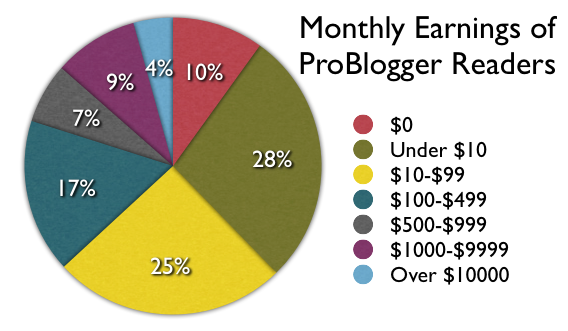
In a recent survey of 1500 ProBlogger readers we asked about their monthly earnings. What you’re seeing below is the spread of earnings from readers who are attempting to make money blogging (note: not all ProBlogger readers attempt to make money, so not all are included in these results).

Keep in mind that ProBlogger readers are generally newish bloggers—about half of those who took this survey had been blogging for less than two years.
So of those trying to make money blogging, 10% don’t make anything and 28% are making less than 30 cents per day. A total of 63% make less than $3.50 per day.
Let’s be clear—most bloggers who are attempting to make money are not making a living from blogging.
Having said that, of the 1508 bloggers surveyed 65 (4%) are making over $10,000 per month (over six figures per year) and a further 9% were doing over $1000 per month (which is at least a part-time level of income).
My feeling, having been attending blogging conferences for six or so years now, is that the number of full-time bloggers is on the rise, and there are actually quite a few more people now at least making the equivalent of a couple of days’ work a week in income from their blogs.
However, most bloggers don’t make much.

6. It takes time to build

When I dig down into the stats from the survey on income levels above, and do some analysis of those who are in the top income bracket, it is fascinating to look at how long they’ve been blogging.
85% of those in that top income bracket have been blogging for four years or more. Almost all of the others had been blogging for three or four years.
This certainly was my own experience. I blogged for a year without making money and once I started monetizing it was around two years of gradual increases before I approached a full-time income level. It would have been four years before I joined that top bracket of income (over $10,000 per month).
Blogging for money is not a get-rich-quick thing. It takes time to build an audience, to build a brand, and to build trust and a good reputation.
And of course even with four or five years of blogging behind you, there’s no guarantee of a decent income.

7. It takes a lot of work

Longevity is not the only key to a profitable blog. The other common factor that I’ve noticed in most full-time bloggers is that they are people of action.
Passivity and blogging don’t tend to go hand in hand.
Blogging as “passive income stream” is another theme that we hear in many make-money-blogging products, however it is far from my own experience.
I’ve worked harder on my business over the last ten years than I’ve worked on anything in my life before this. It is often fun and gives me energy, but it takes considerable work to create content on a daily basis, to keep abreast of what’s going on in the community, to monitor the business side of things, to create products to sell, to build an audience, and so on.
The four main areas to focus upon in building profitable blogs are (click each for further reading):
  1. Creating Great Blog Content
  2. Finding Readers for Your Blog
  3. Building Community on Your Blog
  4. Making Money/Monetizing Your Blog
The key is to build blogs that matter to people, that are original, interesting, and helpful. But this doesn’t just happen—it takes a lot of work.

The 5 basic steps to make money blogging


Here are the five basic steps if you want to make money blogging. I’ll discuss them in more detail as we go, with an emphasis on #5.
  1. Establish your home base
  2. Produce valuable content
  3. Build relationships
  4. Grow your platform (and branch out)
  5. Choose and implement streams of income
If you find yourself getting overwhelmed as you read through, you’re normal! Don’t worry, I’ll give you some tips for starting at the end. Also, please note this post contains affiliate links.
Alright, let’s break it down.

1. Establish your home base

If you want to make money blogging, obviously you’ll need a blog. If you don’t already have one, no worries, simply follow the steps I outlined in How to Start a Blog. This is the easy part (even if you’re not technically-inclined).

2. Produce valuable content

Once you have a blog, write. Draw from your expertise and experience and write informative posts and articles about your chosen topic. Make your content excellent. In order to make money, you must have visitors, but in order to have visitors, you must have content worthwhile to visit.
Writing and producing content is the time consuming part. It’ll be a while before you start seeing an income. There is no way around this. There are no shortcuts. We all have to put in our time.

3. Build relationships

While you create your content, start building genuine and sincere relationships via social media, commenting on other blogs, forums and the like. Reach out to people in your niche. Find people who could use the information you provide. Get to know them, interact, be friendly and helpful by offering no-strings-attached tidbits of your expertise. Building authentic relationships is important for a few reasons:
  • You will establish a reputation of being trustworthy and generous.
  • Your site will be found. People won’t naturally find your site if you don’t put yourself out there.
  • It’s very possible these relationships will turn into much more than just acquaintances to chat with online. These people will likely support you in the future and more than that, they may become fantastic, life-long friends.

4. Grow your platform (and branch out)

Keep growing in the knowledge of your craft so the content you produce gets increasingly great. Use your blog to get exposure, build authority, gain trust and be helpful. (Have I said that before? It’s just so important.)
A lot of people don’t realize that for many bloggers, much of the money they make does not come from their blog directly.
A blog is a platform. It’s online property, a digital home. After proving their trustworthiness, bloggers use their blogs as springboards to launch other projects that bring in income, such as ebooks, books, speaking, products, etc.
Only think about making money once you have earned trust. Many, many people want to skip ahead to the money part, but if you try to dive into monetizing before you’ve really built your platform, you run the risk of damaging the good reputation you so desperately need.

5. Choose and implement streams of income

This is the part you’ve been waiting for—the actual ways people make money blogging.

It’s time to start taking your work seriously


When you sit down to write, don’t publish just another blog post. Don’t give your readers just another tip. Don’t tell just another cute story.
Set their freaking hair on fire.
Write with so much passion and energy and enthusiasm they can’t stay asleep. You want them to feel like somebody shocked them with a defibrillator.
Because that’s what you have to do: bring them back to life. Maybe not forever, maybe not even for a day, but for an hour or two, give them such a charge they feel like a different person.
Do that, and they won’t just move on to the next post, forgetting about you forever.
They’ll write a comment. They’ll share your post with their friends. They’ll subscribe to your blog, so they can come back for more.
And then you can shock them again and again and again until they find their spark for good.
From then on, you’ll be their hero. They’ll think about you every day. You’ll be, quite literally, unforgettable.

How to be unforgettable


It’s not about how smart you are.
It’s not about the professionalism of your blog design.
It’s not even about giving readers tips they can go out and apply immediately.
It’s about the way you make those readers feel.
You want them to cry. You want them to laugh out loud. You want them to shake with anger.
But the most important part?
You want them to feel alive.
You’ve felt it with other art forms, right? You go to a great concert or act or movie, and when it finishes, you feel a little bit different? A little bit more awake?
Well, great writing does that too, and the beautiful part is it can affect people on a mass scale. You can write a great post once, and thousands or even hundreds of thousands of people will be affected by it.
Do you realize how incredibly precious that is?
It means you’re not just here to inform. It means you’re not just here to entertain. It means you’re not just here to persuade.
Those little pixels on the computer screen can change somebody’s life.
After writing this post on ProBlogger, one guy actually emailed to tell me he was planning to commit suicide, and my post talked him out of it. It spoke to him exactly where he was, gave him exactly the message he needed to hear, and reached him at exactly the right time.
Honestly, I feel better about that than all the money I’ve made in my life. I set out to write a post that would affect people, and it did, maybe in the biggest way possible.
The point?

The Seven Tests Every Blog Must Pass


For months, I researched what blogs succeed and fail, and I found seven criteria or “tests” every blog passes before it becomes popular.
And here’s the thing:
To have a viable blog, you need to pass all seven tests. If you can’t, your blog will never succeed, no matter how hard you try.
On a more positive note, passing all seven of these tests practically guarantees you can build a popular blog. All that’s left is doing the work to make it happen.
Ready to find out what the tests are?
Here you go:
  1. Size. The vast majority of popular blogs have a total market size of at least 5 million people. And that’s a minimum. Most top 100 blogs have a total market size of 200 million or more. To be clear, that’s not how many readers they have. That’s how many readers they could have if everyone with an interest in the topic read their blog.
  2. Age. The vast majority of blog readers are between the ages of 30 and 55. If you’re targeting an audience younger or older than that window, such as teenagers or baby boomers, it’s almost impossible to build a popular blog, simply because these people don’t like reading blogs. Not yet, anyway.
  3. Longevity. Because blogs publish content on an ongoing basis, you need an audience that has an ongoing interest. Ideally, it’s a topic like personal finance or social media that changes all the time, and so people want to read about it forever. What you don’t want is a topic like wedding planning or pregnancy, because people are only interested in those subjects for a few months.
  4. Language. In general, blogging as we know it is confined to the English language. Yes, it’s totally possible to build a popular blog in Japanese or Spanish, but the traffic techniques are totally different, and it’s much, much more difficult. In my opinion, it’s far more efficient to use other more traditional methods to build the audience, such as advertising.
  5. Network. For a blog to really take off, you need an audience who is networked with each other through social media. Moms talk with each other on Facebook, foodies hang out on Pinterest, bloggers and journalists are big on Twitter. As a result, they are easy to reach. If your audience isn’t hanging out on a particular social media platform, on the other hand, it’s almost impossible to get any traffic.
  6. Influencer. If a blog topic is viable, you pretty much always find influencers who have already built up their own audiences in the space. Sometimes they are bloggers, sometimes they are podcasters, sometimes they are best-selling authors. The key point: with a little research, you can easily find 5-10 influencers or “thought leaders” already dominating the space. If you can’t find any, there’s always a reason why, and it’s never good.
  7. Desirability. Last but certainly not least, you need to like the audience. Surprisingly, this is the number one reason a blog stalls out following a period of rapid growth. After attracting a small audience, the blogger discovers they can’t stand them, and they stop writing because it’s not fun anymore. The moral of the story: make sure you like the people you are trying to attract because you’ll be hanging out with them for years.

Make Money Blogging: 20 Lessons Going from 0 to $100,000 per Month


Make Money Blogging: 20 Lessons Going from 0 to $100,000 per Month
You know everyone thinks we’re fools, right?
To most of the world, blogging is a joke.
It isn’t a career. It isn’t a way to make money. It isn’t a tool for changing the world.
It’s a hobby, a diversion, a fad that’ll come and go. Sure, you can start a blog, but don’t count on it to take you anywhere. That’s just silly.
Try telling your family or friends or coworkers you want to quit your job and make money blogging. They’ll smile politely and ask, “Does anybody really make money from that?”
Yes, they want you to have dreams. Yes, they want you to chase them. Yes, they want you to succeed.
But they also want you to be “realistic.”
If you really want to improve your life, you should get an advanced degree, write a book, or even start your own business, not hang all your hopes and dreams on some stupid little blog. There’s no money in it.
Or is there?
I’m hesitant to say this, but…

This Blog Makes $100,000 per Month

In January and February, we cleared over $100,000 per month in sales. The verdict is still out on March, but if we didn’t make it, we should be close enough.
How?
Well, I’ll tell you. Not because I want to brag (well, maybe a little), but because most of the advice out there about monetizing your blog is complete crap.
For instance, do you see any ads on this site?
No? How about e-books for sale?
None of those either, huh? In fact, you might be hard-pressed to find anything for sale at all.
There’s a reason why.
Over the past six years, I’ve had the good fortune to work with some of the smartest bloggers on the planet. I worked with Brian Clark as he built Copyblogger to a multimillion dollar brand. Neil Patel and Hiten Shah also hired me to help them launch the KISSmetrics blog, and while they’re not big on publishing revenue numbers, they did recently close a $7 million venture capital round.
Combined, I wouldn’t be surprised if both blogs have earned more than $50 million. In comparison, the $100,000 per month I’ve managed to generate is a pittance.
Want to know how much money you could be making from your blog? Find out with our free Blog Profit Calculator.
But everyone has to start somewhere, right? 😉
The reason this blog has made so much money so fast is I learned from the best, and then when I left, I kept learning. Every day, I crunch numbers, read books, talk to experts, and spend at least 30 minutes in silence, staring into the distance, doing nothing but thinking.
It’s paid off. If you’ll take some of these lessons to heart, it’ll pay off for you too.
Because here’s the thing:

You’re Not a Fool. You Can Make Money Blogging.

So, you want to make a living teaching other people what you know? Nothing wrong with that.
Professors do it. So do public speakers and best-selling authors.
Hell, consulting is a $415 billion industry, and what are all those consultants doing?
Getting paid to teach.
Blogging is no different. It’s just the same old models with some rocket fuel thrown in, courtesy of social media.
In fact, we might as well call that the first lesson:

Lesson #1: You’re Not Just a Blogger

You’re an expert, a teacher, a mentor, maybe even an entrepreneur. Your blog is simply a launchpad for all those things.
Look around, and you’ll find nearly all “bloggers” who make a decent income have books, courses, a side career as a keynote speaker, or even software. That’s how they make money. Their blog is just the “freebie” they give away to attract customers or clients.

Lesson #2: Don’t Sell Advertising

Selling ads is attractive, because it’s passive income, but you can usually make 3-10X more money using the same “ad space” to sell your own products and services or even promote an affiliate product.
Pat Flynn, for example, makes about $50,000 a month in commissions from promoting Bluehost.
Here at BBT, we mostly promote our own products, but we’re also in the process of creating affiliate sales funnels for LeadPages and Stablehost, both of which offer hefty commissions (and are great products too!)

Lesson #3: Build the Funnel in Reverse

We’ve all experienced sales funnels.
A company entices you with a freebie, then they offer you something cheap but irresistible, and then they gradually sweet talk you into buying more and more expensive stuff. It’s a tried and true marketing tactic, and you should absolutely build a sales funnel for your blog.
What you might not know is you should build it in reverse.
A lot of bloggers launch a cheap e-book as their first product, and then they get frustrated when they don’t make much money. Here’s why: the real profit is at the end of the funnel, not the beginning.
Selling e-books is fine and dandy if you have half a dozen more expensive products to offer your customer afterwards, but it’s downright silly if you don’t. You’re much better off creating and selling the expensive product first, and then gradually create cheaper and cheaper products.
When you do have some less expensive products to sell, you can offer those to new people first, safe in the knowledge that you have something more profitable up your sleeve to sell them later.
Here at BBT, our products cost $9,997, $997, and $591. We’re working our way down the funnel in reverse, releasing the most expensive products first and then gradually getting cheaper and cheaper. It’s been much, much more profitable this way.

Lesson #4: There’s No Such Thing As a “Cheap” Market

“But Jon,” I can hear you spluttering. “I can’t sell a $10,000 product! My customers don’t have that much money.”
My response: you’re 98% right. Unless you’re selling exclusively to multimillionaires, the vast majority of your customer base won’t be able to afford premium products, but what’s interesting is it doesn’t matter. Often times, you can make more money selling to the 2% than you can to the entire 98% combined.
For instance, our $10,000 product is a year-long coaching program for writers – a group that’s not exactly known for their wealth, but I always fill all 10 spots within minutes of opening the program. Here’s why: I notify 40,000 writers about it. 2% of 40,000 is 800 people who might possibly buy a product in that price range. By only accepting 10, I’m creating a situation of extreme scarcity.
You can do the same thing, even if your list is much smaller. If you have 100 subscribers, chances are two of them might be willing to buy premium products or services from you, and those two will often pay you more money than the other 98 combined.

Lesson #5: By Charging Premium Prices, You Can Offer Premium Service

Feel guilty about charging that much money? You shouldn’t.
By charging premium prices, you can offer premium service, doing everything possible to help your customers get results. For example, with my coaching program, I get on the phone with students every week, review their homework, answer their questions, look at their blog, and guide them through every step of the process.
Could I put that same information in a $7 e-book? Sure, but I couldn’t give anyone one-on-one help at that price, and that’s what people who buy premium products and services are paying for.

Lesson #6: Deliberately Delay the Sale

Another big shift in thinking: rather than trying to push everyone to buy your products upfront, smart bloggers delay the sale.
I first heard this idea from Rand Fishkin over at Moz. They offer their blog readers a free trial to their Analytics and SEO software, but after studying the behavior of their customers, they noticed something interesting: people who read several blog posts before signing up for a free trial stayed customers for two or three times longer than people who didn’t.
I’ve noticed the same thing with our customers. Instead of immediately clobbering readers with sales pitches, it’s much better to give them some content first and build trust before you begin talking about your products and services. Yes, you’ll make less money in the short term, but the long-term profits go through the roof.

Lesson #7: You Are the Bottleneck

Without a doubt, time is our biggest problem as bloggers. Not only are we expected to publish a continuous stream of content on our blogs, but we also have to deal with technical issues, read books and articles about our field, create new products to sell, answer questions from readers… the list goes on and on. The further into it you go, the more clear it becomes that you can’t do everything.
So, what’s the answer?
Believe it or not, I found answers from studying manufacturing processes. If one machine is working slower than others in a plant, it can literally cost the company tens of thousands of dollars per hour. To make sure it never happens, smart plant managers are willing to spend any amount of money to eliminate bottlenecks. They have an unlimited budget, because the cost of eliminating the bottleneck never comes anywhere close to the cost of the bottleneck itself.
The same is true for us, except the solutions are often different. Instead of buying a new machine, for example, we might purchase a new type of software that automates some of our business, or we might hire a virtual assistant or programmer. It can be expensive, yes, but it’s worthwhile if it saves you enough time, because then you can dedicate that time to higher value activities.

Lesson #8: Measure The Value of Everything You Do

What are those higher value activities, exactly?
Well, it depends on your goal. If your goal is to increase traffic, for example, start measuring the visitors per hour invested. Let’s say you invest three hours in writing a post, and it brings you 100 visitors, and you invest five hours in writing a guest post that brings you 500 visitors. The first activity has an hourly rate of 33 visitors per hour. The second activity has an hourly rate of 100 visitors per hour. Guest posting, therefore, is a better use of your time than writing content on your own blog.
Granted, it’s a short-term perspective, not taking into account long-term gains, but it’s still extremely useful to start measuring your time this way. Not just for traffic, but also for subscriber growth and revenue.

Lesson #9: In the Beginning, Creating Content for Your Own Blog Is Silly

I tried to sneak this one under lesson #8, but I think it’s important enough to get its own number, even if it does get me labeled a heretic and burned at the stake. Because here’s the deal:
In the beginning, your blog is like an empty classroom. Standing in front and giving a lecture is silly, because sure, it might make you feel important, but there’s nobody listening. You’re all alone, and you can come up with the smartest, most entertaining lecture in the history of mankind, but it won’t matter, because no one else heard it.
When you first start out, writing content for your own blog is one of the least efficient ways of building your audience. You’re far better off serving a little time as a “guest lecturer” first. In other words, write guest posts for someone else’s audience, impress the hell out of them, and siphon off a portion of their readership for your own.
That’s what we did here at BBT, and it resulted in the most successful blog launch in history: 13,000 email subscribers in 60 days, before I even wrote a single blog post. We had nothing but a coming soon page and an invitation to join our email list. Sounds strange, but I can promise you it’s vastly more efficient.
You don’t have to wait until you get to 13,000 subscribers to start, but I’d advise accumulating at least a few hundred. That way, you have an audience to share your content when you start publishing posts.

Lesson #10: Don’t Waste Time on Facebook, Twitter, Google+, etc.

Here’s another shocker: you know your dream of building up a huge following on Facebook or Twitter and then using it to promote your blog? Well, it’s a dumb idea. Out of everything we’ve tested, building our own social media accounts produced the lowest visitor per hour figure. In other words, it’s quite possibly the worst way you can spend your time.
Does that mean having followers in those places is useless?
No. Facebook is nice because you can advertise to your followers. Google+ can help boost your search engine rankings. Even with those benefits though, it shouldn’t be near the top of your list for things to do. In my opinion, you shouldn’t think about them at all until you hit 10,000 subscribers, and then outsource the management of them to someone else. You can use your time more efficiently in other places, such as:

Lesson #11: Webinars Kick Butt

If you’ve been on our list for long, you know that we do a lot of webinars. Here’s why: on average, each webinar generates $40,000 per hour invested. It’s by far the most profitable thing I do. Nothing else even comes close. If you’re wondering how on earth we make that much money, all you have to do is attend one of our webinars to find out. Everything we do is on display, and you can study it, free of charge.
Interestingly, webinars are also the most effective way to build our subscriber base. When doing webinars for other people, we average 500 new email subscribers per hour invested. It’s not uncommon to gain 1,000-2,000 email subscribers from a single webinar. If we’re promoting a product, we usually make at least $10,000 too.
Translation: webinars kick butt.

Lesson #12: Longer Content Gets More Traffic

You know what else works? Long content.
It might seem strange, but on average, longer content gets much more traffic than shorter content. Not just for us, but for our students too, regardless of the niche, and here’s a post where SEO expert Neil Patel came to the same conclusion. The sweet spot seems to be about 2,000–3,000 words per post. That’s why posts here on BBT are much longer than your average blog.
Granted, content of that length also takes longer to produce, but if you measure the visitors per hour invested, longer content still wins by a mile. Assuming you’re promoting it, of course.

Lesson #13: Promote The Crap Out of Your Content

The problem is almost no one promotes their content enough. And by “promotion,” I’m not talking about sharing your own posts on Twitter and Facebook. I’m talking about blogger outreach – the process of building relationships with influencers and asking them to share your work.
At a minimum, you should spend just as much time on outreach as you do creating your own content. So, if you’re spending 10 hours a week writing blog posts, you should be spending 10 hours a week on outreach too.
Can’t do that? Then scale back how much content you’re creating. Spend five hours on writing blog posts and five hours on outreach. You’ll get better results.

Lesson #14: Ignore SEO for the First Year

Let’s get one thing straight: I’m not against SEO. Far from it. We now get tons of traffic from Google. I just think most bloggers focus on it way too early.
Again, it all comes down to time. When your blog is new, the most efficient uses of your time fall into three broad categories: building relationships with influencers (including guest blogging), creating content worth linking to, and selling your products and services. If you do those three things well, not only will your blog gain traffic and prominence, but you’ll also start getting search traffic without doing anything.
And then you can focus on other things that matter more, such as…

Lesson #15: Your Email List Is More Important Than Anything Else

In analytics, there is a principle called “the one metric that matters” (OMTM). The idea is that you find a single number that accurately predicts the success or failure of your project.
In the case of blogging, that number is the size of your email list. (Not RSS, mind you – it’s dying a slow but certain death.) In my experience, your email list is the most accurate predictor of how much money you’ll make.
Here at BBT, we make about three dollars per subscriber per month – an impressive feat, due mostly to our skill with marketing. The number isn’t important, though. The point is that I can accurately predict our sales based on the number of subscribers. So can you.
If you’re new to this, I would strive for one dollar per subscriber per month in sales. In other words, an email list of 1,000 subscribers should result in at least $1,000 per month in sales, 10,000 subscribers would result in $10,000 per month in sales, and so on.
The more subscribers you get, the more money you make. Granted, your relationship with your subscribers and the quality of your products or services and dozens of other factors still matter, but to drive revenue, focus on email list growth. To make money blogging, it’s absolutely essential.
Find out how much money your blog could be making – and how quickly you could grow your email list – with our free Blog Profit Calculator.

Lesson #16: Start Selling from Day One

How long should you wait before you begin selling? 1,000 subscribers? 10,000 subscribers? More?
Nope. Start selling from day one. Here’s why:
One of the biggest factors affecting the speed of your growth is who you can hire to help you. Because you’re the bottleneck, remember? So you want to hire a virtual assistant and someone to handle all of the technical details as soon as you possibly can, but of course, that requires money. Hence the need to start selling immediately.
Now, a caveat: don’t turn your blog into a gigantic sales pitch. Nobody likes that. You should, however, be offering something your audience wants and needs. Don’t push them on it, but do make it available, and do remind them from time to time that they can purchase it.

Lesson #17: Your Product Ideas Suck

You probably have all kinds of ideas for things you can sell, right? E-books, courses, maybe an iPhone app? Or a service?
Well, here’s the bad news:
More than likely, your ideas for products suck. The good news is you’re not alone in this position. Everyone’s ideas for products suck, including mine. Here’s why:
We all tend to create products we can see people need, but they’re not aware of it yet. We think if we show them the magnitude of their problem we can convince them to buy our product or service to solve it.
If you’re Steve Jobs, you can do that, but I have more bad news for you: you’re not Steve Jobs. You’re a beginning marketer, and as a beginner, you should only be selling products that solve problems your customer already knows they have. If you have to convince them the problem exists, you’ve already lost the battle.

Lesson #18: Surveys Are Dangerous

So, how do you find what problems exist in the mind of your customer? Traditionally, the answer is a survey, but I’ll warn you: surveys are dangerous. Ask the wrong question, and you’ll get an extremely misleading answer. Use that answer to guide your venture, and you can waste years of your life, not to mention possibly going bankrupt.
If you’re a beginner, I recommend asking one and only one question: “what’s your biggest frustration with <topic> right now?” So, in my case, it would be “what’s your biggest frustration with blogging right now?” That’s it. Nothing more. Look for patterns in the answers you receive, and you’ll learn a ton about what products or services you need to create.

Lesson #19: Start with Services, Then Expand into Products

Once you find a common problem, start offering a service where you solve the problem for your audience. The reason is simple: you can start offering the service immediately. You don’t have to create a product first. You’ll also learn more about the problem as you attempt to solve it yourself.
When I started, for example, I worked as a blog traffic specialist. I was contracted with a few different advertising agencies, and every time they wanted to increase the traffic for a client’s blog, they called me. I didn’t just advise them. I did the work myself, redesigning the site, creating the content, everything.
It taught me a ton about what worked and what didn’t. It was also immediate revenue. The first month I offered my services, I made something like $5,000.
After working for more than a year as a traffic specialist, I felt I really understood the problem and how to solve it, so I created my first product: a course located at guestblogging.com. The first month, it generated something like $30,000 in sales, and now it brings in more than $250,000 per year.
It’s a wonderful product, but here’s the thing: I don’t think I could’ve created it if I hadn’t worked as a service provider first. I wouldn’t have had the knowledge or the money. Keep that in mind when you’re deciding what to offer first.

Lesson #20: Teach Others What You Learned

Now, we come to the reason for this post.
Why on earth would the CEO of the company (me) work for hours to write a post like this, sharing all our secrets? It’s closing in on 4,000 words, for God sakes!
Simple:
It’s my responsibility. If people are ever going to respect blogging as a legitimate business model, those of us who are successful have to speak up and share what we’ve learned. None of us works in a vacuum. The only way we can advance our field as a whole is to collectively share what we’ve learned.
And it is a field. There are thousands of people around the world making a living from blogging. The problem is, there’s not a repository, a central community where we can all talk and learn from each other. Over the next few months, that’s something we’re going to change.
In the meantime, could you do me a favor?
Share this post. Not just so it’ll get me traffic, but so other people can see that you really can earn a legitimate income from blogging. Maybe reading this will even help them do it.
After all, isn’t that what we’re here to do? Help people?
In the end, that’s what I love most about blogging: every article we publish, every course we create, every coaching call we do can change somebody’s life. Maybe not always in a big way, but we touch thousands upon thousands of people, and we make their lives just a little bit better. We inform them, we inspire them, we give them the roadmap for achieving their dreams.
And the best part?
We get paid for it. It’s our job.
I just wish more people knew it was a viable career. Let’s change that, shall we?

Monday, March 14, 2016

7 Makanan Luar Negeri yang Cara Makannya di Indonesia Beda Banget dengan Negara Asalnya ....

7 Makanan Luar Negeri yang Cara Makannya di Indonesia Beda Banget dengan Negara Asalnya ....

Meski memiliki kekayaan kuliner, masyarakat Indonesia tidak menutup diri untuk menerima makanan dari luar negeri. Sejak tahun 1980an, banyak restoran dan rumah makan siap saji dari luar negeri yang bertandang dan membuka gerainya di Indonesia. Kala itu masih berpusat di kota-kota besar saja seperti Jakarta, Semarang, dan Surabaya. Tapi sekarang sudah tersebar di berbagai kota dan propinsi.

Meski masyarakat Indonesia menerima makanan dari luar negeri tersebut - bahkan telah menjadi tren gaya hidup mereka untuk makan makanan produk luar negeri - tidak serta merta cara makan dan bentuk penyajian makanan luar negeri tersebut mentah-mentah diaplikasikan begitu saja di Indonesia. Butuh beberapa penyesuaian agar makanan tersebut bisa diterima, mulai dari penggunaan bumbu (yang disesuaikan dengan selera lidah orang Indonesia), hingga pada cara penyajian dan cara makannya.

Berikut ini adalah makanan "impor" dari luar negeri yang ada di Indonesia, di mana cara penyajian dan cara makannya di Indonesia dibuat berbeda dengan cara makan di negeri asal makanan tersebut, agar bisa diterima masyarakat Indonesia. Meski beberapa di antaranya terkesan konyol, tapi.... well... you know..... itulah uniknya makan makanan tersebut di Indonesia.....


1. PIZZA
Anda tentu tahu kalau pizza adalah makanan khas masyarakat Italia. Makanan yang terbuat dari tepiung terigu ini disajikan dalam bentuk bulat tipis dengan topping daging, paprika, dan keju.

Sama seperti Indonesia, pizza juga ada dan diperkenalkan oleh sebuah restoran franchise sejak tahun 1990-an. Sejak itu, pizza menjadi salah satu menu makanan favorit keluarga yang sangat digemari Selain harganya kini telah dibuat menyesuaian kantong masyarakat Indonesia, mulai dari menengah hingga atas, menu yang disajikannya pun sangat beragam, seperti nasi, pasta, ayam goreng, dan lain-lain, yang mana membuat menu pizza menjadi tidak membosankan.

Karena awalnya hadir sebagai "makanan luar negeri", di mana makan dengan sendok dan garpu menjadi ciri khas masyarakat barat, maka jika Anda makan di restoran tersebut, di meja selalu disediakan sendok dan garpu.  Makan pizza pun dilakukan dengan menggunakan sendok dan garpu. Sangat jarang sekali ada orang makan pizza dengan cara memegang potongan pizza-nya.

Padahal di luar negeri, cara mengonsumsi pizza ya biasa saja : Dipegang dengan tangan dan dimakan begitu saja.

Well... mungkin biar keliatan makan pizza itu bergengsi dan terlihat seperti gaya makan orang kelas atas, sehingga makan pizza di Indonesia harus menggunakan pisau dan garpu.


2. DONAT
Donat adalah salah satu makanan yang "dipercaya" berasal dari Amerika Selatan dan diciptakan oleh masyarakat Belanda yang berimigirasi di negara tersebut pada abad 18. Kini donat adalah makanan yang sangat populer di seluruh dunia dan diminati banyak orang, termasuk di Indonesia. Jika sering menonton film Hollywood, maka Anda akan melihat kalau donat menjadi "jajanan favorit" polisi di Amerika Serikat.

Di Indonesia pun, donat juga hadir di tahun 1990an dan dibawa oleh sebuah restoran waralaba donat terkemuka dari luar negeri. Sama seperti negara asalnya, donat dijual dalam berbagai bentuk. Tidak saja bulat berlubang tengah seperti kebanyakan donat pada umumnya, namun juga dalam bentuk gepeng dan bundar.

Jika di luar negeri, cara makan donat adalah dimakan dengan cara memegang donat dengan tangan dan memakannya langsung, maka di Indonesia sedikit berbeda. Dengan alasan makanan tersebut adalah makanan dari luar negeri dan ingin tampak "berkelas" saat disajikan, maka jika makan donat di restoran waralaba donat, sama seperti makan pizza, makannya menggunakan pisau dan garpu. Sebenarnya "cukup aneh", mengingat donat berukuran kecil dan sedikit "berlebihan" jika dimakan dengan pisau dan garpu. Tapi..... namanya juga makan makanan bule, ya afdolnya dimakan gaya bule juga.


3. BIBIMBAP
Ini adalah salah satu makanan tradisional sekaligus populer di Korea Selatan. Makanan ini berupa nasi dengan daging dan sayuran serta kuning telur setengah matang. Cara makannya terbilang unik : nasi dan lauknya dicampur aduk. Setelah tercampur merata, barulah dimakan (Bibimbap sendiri dalam bahasa Korea berarti "nasi campur aduk").

Di Indonesia, Restoran Korea baru mulai populer dua tahun terakhir ini setelah wabah budaya Korea menulari masyarakat Indonesia. Banyak sekali restoran waralaba Korea yang belakangan ini bermunculan di berbagai kota besar di Indonesia. Dan Bibimbap menjadi salah satu menu andalan yang disukai banyak orang. Sebenarnya penyajiannya nyaris persis sama dengan penyajian di negara aslinya. Bedanya hanyalah pada telornya. Jika di negara asalnya, telur yang digunakan adalah kuning telur setengah matang, maka jika di Indonesia, telur disajikan lengkap dengan putih telur dan dimasak matang. Selain alasan higienis (telur setengah matang masih mengandung bakteri berbahaya seperti Salmonella yang dapat membuat orang sakit perut jika mengonsumsi), banyak orang tidak suka dengan aroma kuning telur yang amis dan menyengat.

Lebih parahnya lagi, dengan mencampur telur ke nasi dan lauk pauk akan membuat wujud makanannya menjadi sangat tidak menarik (jadi lebih mirip makanan buat doggy....). Dengan pertimbangan itulah, maka beberapa restoran waralaba memutuskan untuk menyajikan telur mata sapi matang. Ada sih yang menyajikan Bibimbap dalam versi aslinya. Biasanya restoran seperti itu adalah restoran yang dibuka oleh Korea dan diperuntukkan bagi para ekspatriat Korea.


4. CAKWE
Cakwe adalah semacam roti panjang yang digoreng. Panganan yang aslinya dari Daratan Tiongkok ini biasanya merupakan menu sarapan masyarakat di sana (serta Hong Kong). Cakwe biasa hanya dimakan layaknya roti (tanpa tambahan apapun) atau dimakan bersama bubur polos (cakwe dipotong-potong kecil lalu diceburkan ke bubur atau hanya dicelup-celupkan di bubur saja, untuk penambah rasa dan aroma bubur).

Di Indonesia, Cakwe awalnya populer di daerah Sumatera, khususnya Medan dan Kepulauan Riau. Kini kehadirannya sudah merambah dan dikenal hampir semua wilayah di Indonesia, khususnya Kalimantan dan Jawa. Namun berbeda dengan cara makan di negara asalnya, cakwe justru dimakan dengan dicocol saos sambal, saos tomat, atau bumbu kacang.

Cakwe juga digunakan sebagai salah satu komplemen makan bubur ayam, selain suwiran daging ayam, potongan telur, seledri, dan bawang goreng. 


5. BAKPAO
Salah satu makanan yang juga aslinya dari Daratan Tiongkok dan kini sudah sangat populer di Indonesia. Terbuat dari terigu yang dibentuk bulat dengan isi daging di dalamnya. Dalam bahasa aslinya, Bakpao sendiri berarti "daging yang dibungkus". Makannya juga sangat simpel, yaitu dengan memakan bakpao seperti makan roti.

Namun berbeda dengan Indonesia, terutama di daerah Jawa, makan Bakpao biasanya menggunakan saos sambal atau saos tomat. Tujuannya untuk mendapatkan "sensasi" rasa yang berbeda. Ada sih orang yang makan bakpao tanpa saos, tetapi kebanyakan orang Indonesia lebih suka makan bakpao dengan saos untuk mencari sensasi pedas dan asam.


6. SIOMAY
Siomay berasal dari bahasa Tiongkok Shumai / Saomay yang berarti "pangsit daging babi". Salah satu makanan bergengsi ini biasanya merupakan salah satu menu dimsum yang biasa dinikmati oleh orang Tiongkok dan Hong Kong.

Seperti dimsum pada umumnya, Saomay disajikan dalam keranjang rotan dan dimakan selagi hangat dan dicocol ke dalam campuran minyak wijen, arak, dan kaldu ayam sebagai penambah rasa.

Di Indonesia, karena penduduknya kebanyakan orang Muslim, maka Siomay dibuat dari daging ikan dan tepung tapioka. Cara makannya pun berbeda : Siomay dipotong dalam ukuran sedang, lalu dituangi bumbu kacang dan kecap manis.


7. MARTABAK
Martabak adalah makanan yang berasal dari Yemen, Timur Tengah. Dalam bahasa aslinya, Martabak atau Murtabbaq berarti "dilipat". Aslinya, martabak terbuat dari kulit roti yang lebar dan dilipat-lipat, lalu digoreng. Bentuknya sekilas mirip roti croissant dari Perancis, namun lebih lembut dan legit. Martabak disajikan dalam bentuk potongan segi empat dan dituangi bumbu kaldu kental yang terdiri dari daging kambing, telor, potongan timun, bawang merah, dan tomat.

Martabak Asin

Di Indonesia, Martabak terdiri dari 2 jenis, yaitu Martabak Asin dan Martabak Manis. Martabak Asin adalah martabak yang terbuat dari kulit roti yang dibuat lebar, lalu di dalamnya diisi dengan campuran daging cincang, telor, dan daun bawang, kemudian digoreng. Martabak dimakan dalam kondisi kering dengan tambahan kecap asin dan acar cabe rawit, timun, dan bawang merah yang segar.

Di Palembang, ada Martabak bernama Martabak HAR (Haji Abdul Rozak) yang penyajiannya sangat mirip dengan martabak di negara asalnya.

Martabak Manis
Sementara itu Martabak Manis adalah martabak yang terbuat dari tapioka. Mirip martabak asin, hanya saja bentuknya bulat dan rasanya manis. Biasanya Martabak Manis diberi gula, coklat, mentega, kacang halus, keju, dan lain-lain sesuai selera. Biasanya Martabak seperti ini dikenal dengan nama Martabak Bangka, karena pertama kali dijual dan diperkenalkan oleh orang-orang dari Pulau Bangka, Sumatera Selatan. Meski namanya Martabak, namun konsep Martabak Manis atau Martabak Bangka sangat jauh berbeda dengan Martabak asli. Yang menyamakan keduanya adalah dalam penyajiannya saja, di mana Martabak Bangka juga disajikan dalam bentuk "terlipat".